

Sometimes history doesn’t announce itself with a dramatic discovery. Sometimes it arrives quietly, in the form of two broken clay pipes pulled from the soil.
Over the years we’ve uncovered our share of artifacts while restoring our 1767 Spaulding farm—old coins, hand-forged hardware, flintlock parts, pottery fragments, and countless reminders that generations of people lived and worked this land long before we arrived. Most are mysteries waiting to be solved.
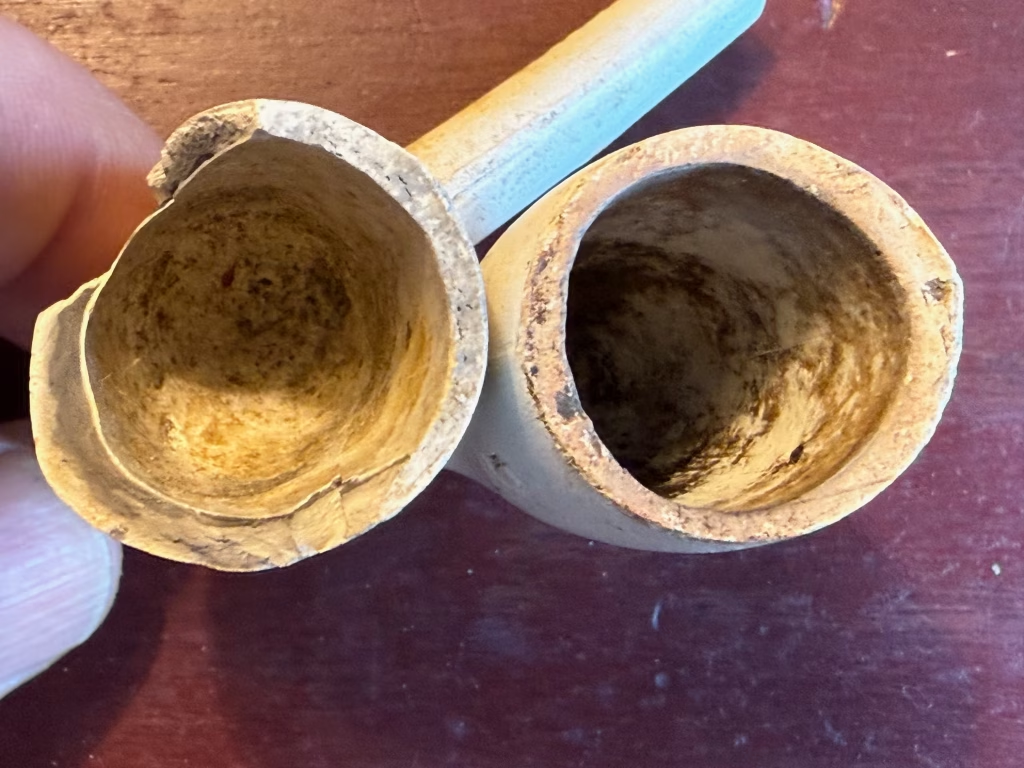
Recently, while working around the farm, I found two nearly identical white clay smoking pipes. Both were broken, but each still retained much of its bowl and stem. At first glance they looked old, but there was little to suggest exactly how old or who had made them.
Like most discoveries on the farm, curiosity quickly turned into research.
Looking for Clues
The first clue appeared on the side of each bowl.
Both pipes carried the letters “TD.”
For nearly three centuries those two letters have puzzled collectors and archaeologists. Originally associated with English clay pipe makers during the seventeenth century, the initials eventually became a widely recognized mark used on export pipes shipped throughout Britain and North America. By the nineteenth century, the “TD” mark had become almost a brand of its own.
That told me the pipes were likely imported, but not who had made them.
The next clue was much smaller.


Beneath each bowl, stamped into the tiny heel of the pipe, was the number 49. Another number—78—appeared on the stem. At first I wondered if they might represent dates, but further research suggested they were almost certainly factory mold or pattern numbers.
The biggest breakthrough came from the stem itself.
The lettering was badly worn, but under raking light I could finally make out part of a name:
McDOUG…
Turning the pipe over revealed another word:
GLASGOW.
Suddenly the mystery had a home.
Made in Glasgow, Scotland
The pipes were manufactured by McDougall & Co. of Glasgow, Scotland—one of the largest clay pipe manufacturers in the world during the nineteenth century. Beginning in the 1840s, McDougall exported millions of inexpensive white clay pipes throughout the British Empire and North America. Their products were stamped “McDOUGALL” on one side of the stem and “GLASGOW” on the other, exactly as these pipes are.
Because these pipes are stamped “GLASGOW” rather than “SCOTLAND,” they were almost certainly made before 1891. After the McKinley Tariff Act took effect in the United States, imported goods were generally required to identify their country of origin, and McDougall changed many of its markings to include “SCOTLAND.” That places these pipes somewhere between about 1848 and 1891, with the most likely manufacturing date falling between 1865 and 1885.
What had once been anonymous fragments had become identifiable artifacts with a manufacturer, a city of origin, and a probable age.
A Familiar Habit on the Farm
The discovery reminded me of another small piece of the Spaulding story.
While restoring the barn several years ago, I uncovered a hidden stash tucked inside one of the old timber beams. Among the items was a quantity of pipe tobacco carefully stored away decades ago. At the time I couldn’t help wondering if it had belonged to Loyal Wright Spaulding, the last Spaulding to own the farm, or perhaps another member of the family.
Those hidden remnants suggested that someone on the farm enjoyed smoking a pipe.
Now, finding not one but two well-used clay pipes, I can’t help but wonder whether they belonged to the same family—or perhaps to an earlier generation altogether.
Of course, there is no way to know.
These pipes could have belonged to Loyal Spaulding.
They could just as easily have belonged to his father, his grandfather, a hired farmhand, or even a visitor who stopped by during haying season.
What we do know is that both pipes were heavily smoked. The bowls still contain the dark carbon residue left behind by countless bowls of tobacco. These were not decorative objects or keepsakes. They were everyday tools that accompanied someone’s work, conversations, and quiet moments on the farm.
Ordinary Objects Tell Extraordinary Stories
It is easy to overlook humble artifacts like clay pipes.
Unlike silver spoons or military buttons, they rarely attract much attention. Yet archaeologists often value them because they can be remarkably informative. Manufacturers changed marks, molds, and styles over time, allowing researchers to date them surprisingly well.
In this case, two inexpensive clay pipes reveal something larger.
They remind us that even a farm in rural Vermont was connected to the wider world. These pipes began life in an industrial factory nearly 3,000 miles away in Glasgow, crossed the Atlantic aboard a sailing ship, were sold through merchants somewhere in North America, and eventually found their way into the hands of someone standing right here on this farm.
For a few pennies, a farmer in Panton could buy a Scottish-made clay pipe and carry it into the fields.
More than a century later, those same pipes emerged from the soil to tell their story once again.
History often survives in the smallest things.
Frequently Asked Questions
Based on the manufacturer’s marks and historical evidence, the pipes were likely made between 1865 and 1890 by McDougall & Co. of Glasgow, Scotland.
The letters “TD” became one of the best-known marks used on clay tobacco pipes. Originally associated with early English pipe makers, the initials were later adopted by several manufacturers, including McDougall, on pipes exported throughout Britain and North America.
The pipes were manufactured by McDougall & Co. in Glasgow, Scotland, one of the world’s largest clay pipe manufacturers during the nineteenth century.
There is no way to know for certain. However, the pipes were found on the Spaulding farm and date to a period when the family occupied the property. They may have belonged to a member of the Spaulding family, a farm worker, or a visitor.
During the nineteenth century, inexpensive goods from Britain were widely imported into the United States. McDougall exported millions of clay pipes, many of which were sold by merchants throughout New England.
Continue Exploring the History of Our Farm
Every discovery seems to uncover another piece of the story. If you enjoyed this article, you may also like these related posts about the history, artifacts, and families that shaped our 1767 Vermont farm.




Share Your Thoughts