

Seeing the Structure Anew
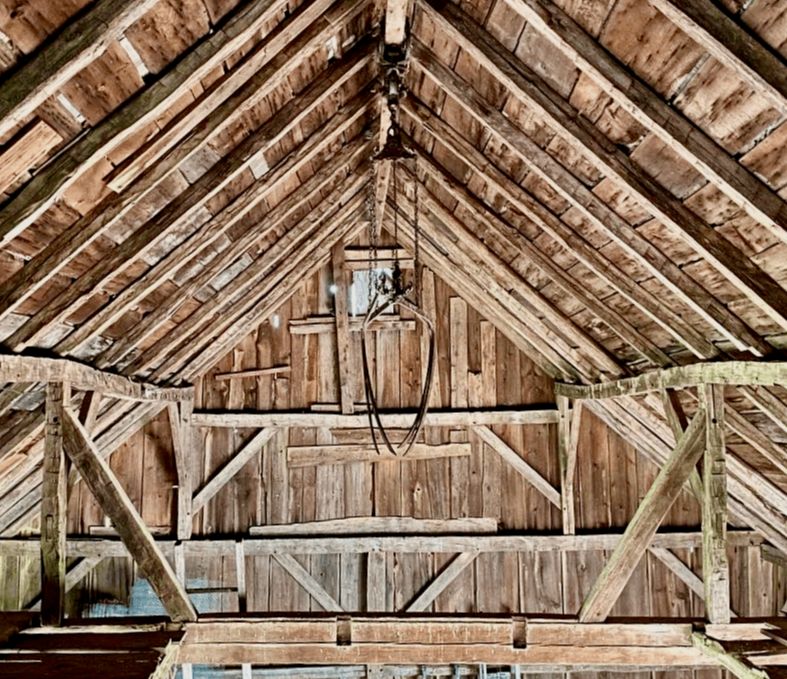
After clearing and stabilizing the old barn, we finally stepped back and took it in. What had once looked weathered and tired revealed extraordinary craftsmanship beneath the dust — a living example of early Vermont timber framing. The joinery, the beams, the symmetry — everything spoke of careful design and the enduring skill of the people who built it, especially in the context of gunstock timber. The importance of maintaining gunstock timber frame structures in Vermont cannot be overstated.
Understanding Gunstock Timber Framing
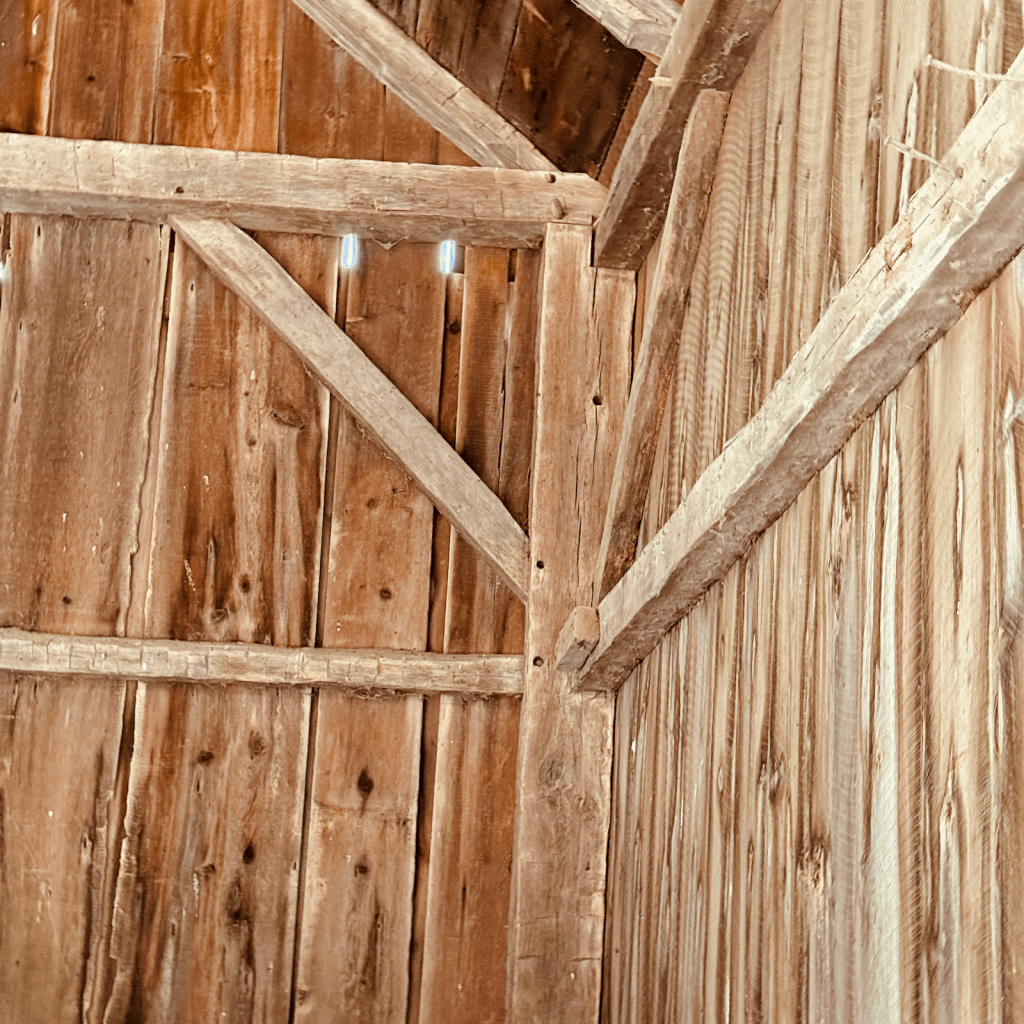
Our barn, built in the late 1700s and expanded in the early 1800s, is a gunstock timber frame Vermont structure. In this traditional English method, the vertical posts flare at the top — like the stock of a gun — allowing them to support connecting timbers such as tie beams, rafters, and girts. This flared design balanced strength and simplicity, making it ideal for the rugged Vermont climate and the ingenuity of early farmers.
Post-and-Beam Tradition in 18th-Century New England
This barn is also part of a wider building tradition. In the eighteenth century, most New England barns and houses were built using heavy post-and-beam framing, often called English common framing. Large squared timbers formed the skeleton of the building, joined with mortise-and-tenon joints pinned by hardwood pegs.
Carpenters used:
- Posts to anchor the corners and walls
- Girts, tie beams, and summer beams to tie the frame together
- Massive sills resting on stone
- Diagonal braces to prevent racking
- Common rafters perched on plates or tie beams
Builders typically selected straight oak, pine, or chestnut trees, squared them by hand, scribed each joint on the ground, and assembled entire bents — the upright wall sections of a timber-frame building — before raising them skyward with the help of neighbors.
This method produced buildings strong enough to endure centuries of snow loads, wind, and seasonal movement — which is why so many historic Vermont barns still stand today. Structures like these gunstock timber frame Vermont barns symbolize durability. Yet time has taken its toll, and many barns across the state, like ours, are in need of costly structural repair.
Selecting Your Tree
The Spaulding family may have chosen the Champlain Valley partly for its valuable trees. Many native species still flourish on our land today — descendants of the primal forest the Spauldings first encountered.
Apple trees offered nourishment. Red cedar and hemlock added durability. But the backbone of any strong barn came from white oak and bur oak — dense, rot-resistant, and remarkably strong.
Many mature oaks still stand along the property lines and rock outcrops. The largest measures 46 inches across and is estimated to be 240–250 years old, likely sprouting around the very time the Spauldings settled in Panton. It’s tempting to imagine it grew from the acorn of a tree they felled for their original barn.
Tools of the Trade
To build a home or barn in the late 1700s, especially a gunstock timber frame in Vermont, you needed skill, neighbors, and the right tools. Here are a few of the essential tools early builders reached for first.
It all began with the felling axe.
By the 1790s, American-style axes had evolved from lighter British forms into heavier tools with a distinct poll opposite the bit. That weight gave each swing more force, making it easier to bring down tall pines, hemlocks, and oaks.
Once the tree was down, the shaping began.
Once a tree was felled, limbed, and hauled to the barn site — often by horse or oxen — the real shaping began. A broad axe, with its chisel-edged blade and offset handle, was used to square round logs into beams. This was where real craftsmanship emerged: one steady, confident stroke after another.

Figure 1. Illustration from Eric Sloane, A Museum of Early American Tools (New York: Funk & Wagnalls, 1964; Dover reprint 2002), p. 17. Used for educational and commentary purposes.
Standing in the barn today, it’s easy to imagine early farmers working outdoors — the ring of iron on wood, the scent of fresh-cut timber, and the pride in crafting each beam.
A Story Told in Wood
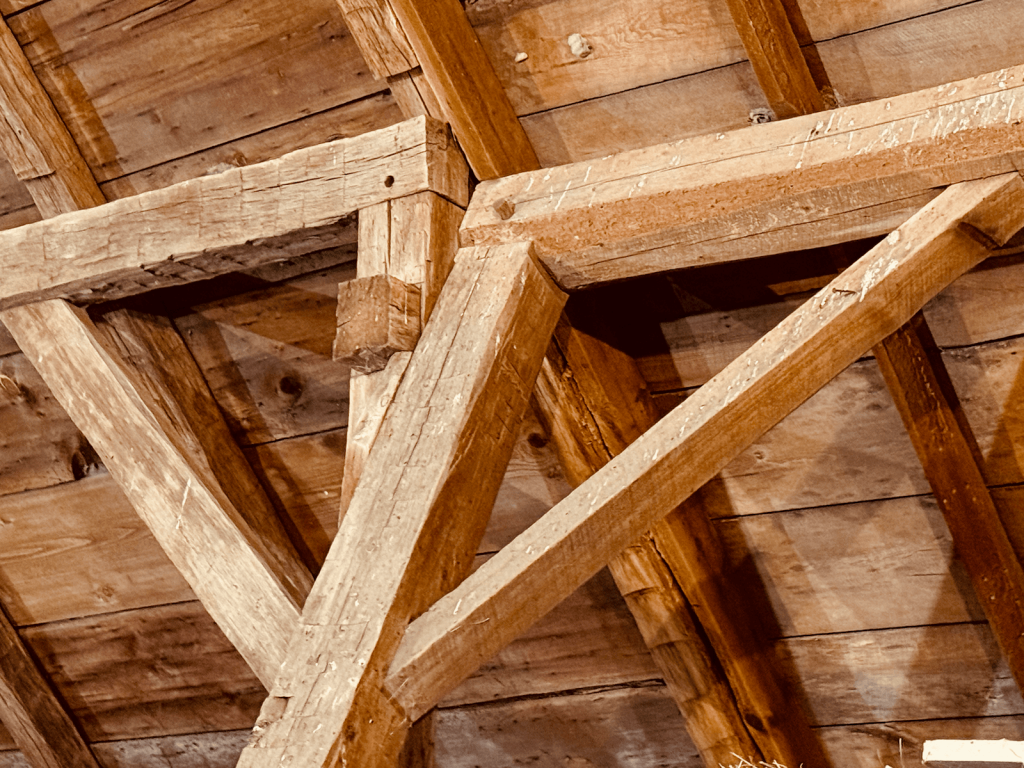
The original 30×40-foot section of the barn was entirely hand-hewn and scribed. Every joint fits with remarkable precision, secured with wooden pegs that have held strong for more than two centuries.
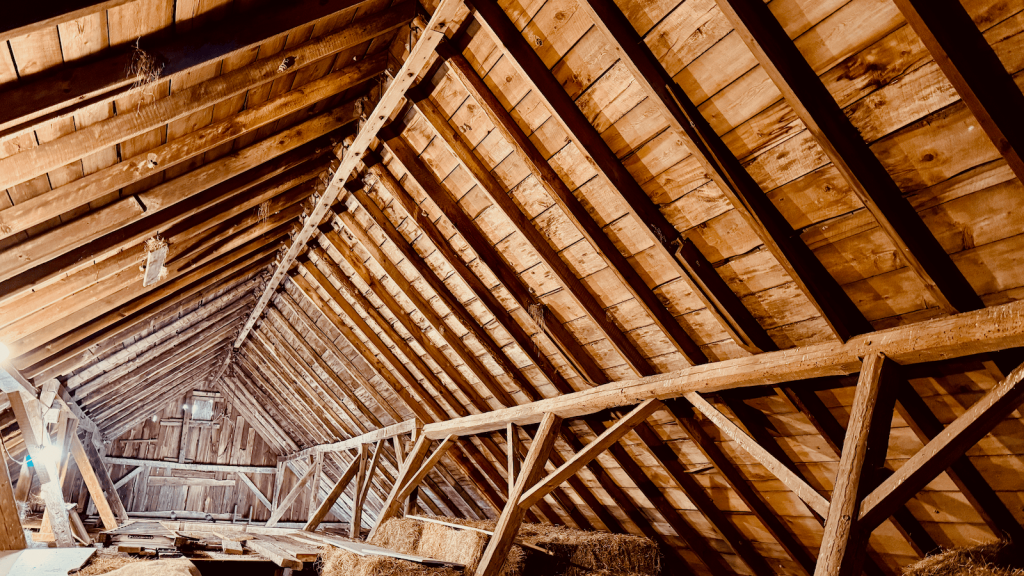
Later, likely during Vermont’s “Merino Mania,”² the barn expanded by an additional 35 feet. The sawn timbers in this newer section point to the rise of a water-powered sawmill, probably in nearby Vergennes. As the region changed — more sheep, more hay, more storage — the barn changed with it.
Reading the Barn’s Evolution
You can still read that evolution today. Rough-hewn beams sit beside smoother saw-cut posts. A hand-forged hinge hangs on a door secured with wire nails. The slate roof likely dates to the same era of growth. Each detail reflects the handoff between generations — one era’s craftsmanship meeting another’s adaptation.
A Personal Connection
After learning how the Spauldings selected their trees, shaped each beam by hand, and raised entire bents with the help of neighbors, it’s impossible to look at this barn the same way. Every timber carries a mark of that labor and cooperation. The craftsmanship, the Merino-era expansion, the scars of weather and time — they all add up to a structure that feels less like a building and more like a companion to the land. This barn doesn’t just stand here. It endures, teaching us how it was made and why it mattered.
Continue the Story
If you missed a part of our three part series, you can read it here:
Part 1: Cleaning Out and Saving the Barn
Part 2: The Craft of a Gunstock Barn
Part 3: A Barn Through Time — Farming, Families, and the Changing Landscape of Addison County
To explore more of the Spaulding family’s legacy:
Historic Spaulding Homestead
Discover the Spaulding Family History
Footnotes
¹ Eric Sloane, A Museum of Early American Tools (New York: Funk & Wagnalls, 1964; reprint, Mineola, NY: Dover Publications, 2002), p. 17.
² “William Jarvis and the Merino Sheep Craze,” Vermont Historical Society, accessed October 2025, https://vermonthistory.org/william-jarvis-and-the-merino-sheep-craze



Share Your Thoughts