

Back in 2019, when our son and daughter-in-law first sent us the listing for what is now our property — as a joke, since the house and barn hadn’t been lived in for over 20 years — we were intrigued. The age of the house and barn, combined with the beauty of the surrounding area, drew us in and inspired our journey into historic Vermont barn restoration.
We’ve owned several historic homes over the years: a half cape built around 1790 on Seaview Street in Chatham, Cape Cod, and Asa Burton’s 1790 homestead in East Thetford, Vermont. Reverend Burton, a Dartmouth graduate, later served on the boards of both the University of Vermont and Middlebury College. While both of those homes carried deep history, this farm felt different — its past still visible in the weathered beams, worn floorboards, and the everyday objects left behind. These included horseshoes and ox yokes, hay forks and cooking utensils, hand-forged nails and hinges, even a sherd of pottery, a clay smoking pipe, and a few coins buried in the dirt.
Discovering the Barn’s Condition
Stepping inside the barn was like opening a time capsule. It was filled with long-forgotten belongings: Christmas decorations, well-worn furniture, and all manner of farming essentials — milk cans, yokes, horse shoes, hay forks, and shovels. Mixed among these treasures were less charming finds: old tires, paint cans, compressors, mattresses, and even a fifty-gallon drum of motor oil.
Yet among the piles, we uncovered artifacts of true historical value. These included hand-forged hardware, weathered lumber, and farm tools carrying the marks of generations past.


But the barn itself was in trouble. The north end had sunk into the ground. Rot had eaten away at the sills, and several support beams had pressed deep into the soil, twisting the frame and threatening the entire structure.
Understanding the Structure
This barn follows a gunstock-post frame design, a style that came to New England with English settlers. In this method, vertical posts flare — or “gunstock” — at the top, creating a wider bearing area. This supports multiple connecting timbers like plates, girts, tie beams, and rafters. This style, common in the 17th and 18th centuries, remained in use into the early 1800s.
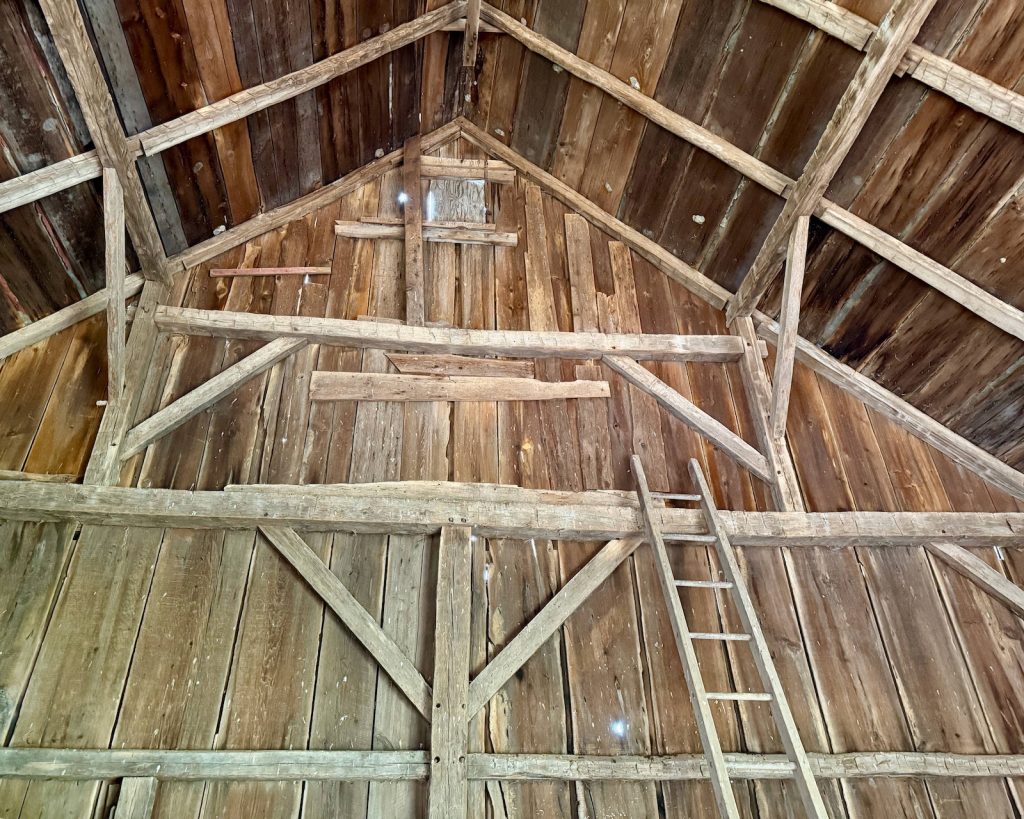
Gunstock barns rely on hand-hewn timbers, scribed layouts (each timber fitted to its mate), and mortise-and-tenon joints secured with large wooden pegs. This craftsmanship helped these barns survive for centuries.
Clearing the Space
Before making any repairs, we tackled the cleanup. We saved every item of historical or practical value — old lumber, doors, window sashes, and hand-forged metalwork — and sorted the rest for disposal. Three very large dumpsters later, the barn finally stood clear enough to assess. We could then plan its next chapter.


Stabilizing the Barn
We connected with Kelley Connor of Bridport, Vermont, just “down the road a piece.” Coming from a long line of farmers, Kelley knew barns inside and out. He jacked up the north end, replaced the rotted sills, spliced in new posts, and reset the stone foundation. His careful work relieved the strain on the mortise-and-tenon joints and restored the barn’s balance.
Thanks to Kelley’s expertise, the structure no longer sagged or shifted. The barn that once seemed on the verge of collapse stood strong again. It was ready to tell its story for another hundred years.
What began as a daunting cleanup turned into a restoration and a connection to Vermont’s early farm history. What was once a liability had become the foundation for a much bigger story. It is one that stretches back through Addison County’s past and forward into the future of Wiggly Goat Farm.


Continue the Story
If you missed a part of our three part series, you can read it here:
Part 1: Cleaning Out and Saving the Barn
Part 2: The Craft of a Gunstock Barn
Part 3: A Barn Through Time — Farming, Families, and the Changing Landscape of Addison County
Read more about the Spaulding family’s 177-year history in Panton, Vermont and how this land has carried stories through generations.




Share Your Thoughts