

What do hardy kiwi, a trellis, and a dead guy have in common?
While renovating our old house and barn, I have heard a number of stories about the Spaulding family, who farmed this land for five generations. One story that is often recounted is that of a dead soldier.
The other day, I was digging a hole for a cedar post as part of a trellis for hardy kiwi plants. I have found countless things in the dirt around the property: horseshoes, people shoes, pottery, bottles, and all sorts of bits and pieces of farming equipment. But that day, I found a large metal button.
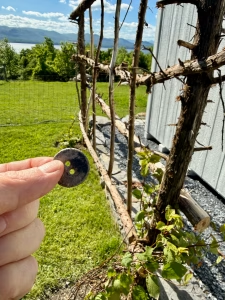
It got me thinking about the old tale of a soldier who was found dead in the house and buried somewhere on the property, British or French depending on who is telling the story.
What are the chances this is a button from a dead soldier?
So I thought I’d try a different kind of digging.
What I Discovered
This supposedly happened after the Battle of Valcour in 1776 and a skirmish in what is now known as Arnold’s Bay. Benedict Arnold and his men, after a relentless battle and escape down Lake Champlain, were retreating on foot from Arnold’s Bay to Crown Point while being pursued by British forces.
Lo and behold, recorded in the Vermont Historical Magazine of 1859, Isaac Spaulding recalled a story told to him by his father, Phineas Spaulding Jr., a few years before Phineas’ death. According to the story, a traveler once called upon the Spaulding house and claimed to have been in the engagement at Arnold’s Bay. He said he had been one of the British soldiers who followed Arnold’s men some distance over land.
A man named McDonald, was unable to go any farther. He was carried into a deserted house by his comrades and left behind. When the Spaulding family returned after the hostilities, Henry Spaulding, Phineas’ brother, found a dead body in the house.
The fact that the soldier is remembered by name is unusual. Most frontier stories involve an “unknown soldier,” but this account specifically identifies the man as McDonald. The surname suggests he may have been Scottish, which would not have been uncommon among British troops serving in Canada during the Revolutionary War.
What happened next remains something of a mystery. The story says the soldier died in the house and was buried on the property. Today, the Spaulding family cemetery still exists, and many members of the family are buried there, including Isaac Spaulding himself. Yet I have never found a marker bearing the name McDonald. If he was buried here, where exactly is he?
What about a possible French soldier? If a French soldier had died in the area during the French and Indian War, it would have been before 1763, when the Spaulding family had not yet settled the area. Given that the French were not keen on being pushed out of North America by the British, it is hard to imagine a French soldier serving alongside British forces in 1776.
Falling Through A Button Hole
As for the button I found while digging the post hole, I have no idea whether it belonged to a soldier, a farmer, a traveler, or a child who lost it two centuries ago. But it was enough to send me down a historical button hole and uncover a story that has been tied to this property for generations.




Share Your Thoughts