

In our last article, The Spaulding Homestead, we touched upon the rich history of the Spaulding family, who settled in Panton in 1767. As promised, here’s more of their story.
Before we dive in, I want to acknowledge the source of much of the information shared below. While researching the history of Panton and its earliest settlers, I was fortunate to discover History of Addison County, Vermont, edited by H.P. Smith and published by D. Mason & Co. in Syracuse, NY, in 1886. This detailed and fascinating work has provided invaluable insight into the region’s past. Much of the text below consists of excerpts from the original work. I have arranged them chronologically with subheadings and made some additions for clarity and ease of reading.
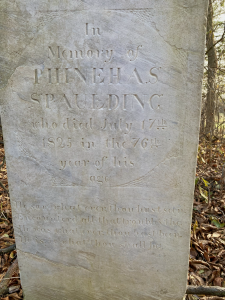
One additional note: Over time, I have found the Spaulding name spelled both with and without a “u.” In the History of Addison County, Vermont it is spelled Spalding. So, which is correct? I took a walk across Lake Road to the Spaulding Family Cemetery, where Phineas’s headstone rests. Is carved S-P-A-U-L-D-I-N-G—so we’ll go with that.
The Charter of Panton – 1761
Panton was chartered by the Royal Governor of New Hampshire, Benning Wentworth, on November 3, 1761, to James Nichols and sixty-three others, who were mostly citizens of Litchfield County, Connecticut. These grantees supposed they were acquiring title to 25,000 acres of land, “extending seven miles west and six miles south from the lower falls of the Great Otter Creek.”
Spauldings Settle in Panton – 1767
Phineas Spalding, whose name often appears in the records of the town, was born in Plainfield, Connecticut, in 1720, and came here from Cornwall with a large family of children by way of Fort Edward and Lake George in 1767, stopping in what he supposed was Panton, of which he was one of the original proprietors. He remained on what was later known as the Swift farm until November 5, 1778, when his house and goods were burned and two of his sons were taken prisoner. He escaped to Rutland and died there not long after.
Panton and the Battle of Valcour – October 11, 1776
Of this event and other incidents connected therewith, we quote as follows from the sketch furnished to the Vermont Historical Magazine by Judge Smith:
“Events had by this time occurred within the immediate neighborhood that convinced them [the inhabitants of Panton] that they could not remain inactive spectators of the struggle in their exposed locality. The year before, Ethan Allen had sent Captain Douglass of Jericho to Panton to consult his brother-in-law and procure boats to assist in carrying his men across the lake to attack Ticonderoga. Among the reinforcements sent to Canada under General Thomas after the death of the lamented Montgomery and so many of his brave companions was Edmund Grandey, the father of the late Judge Grandey and brother of Elijah Grandey, then living in Panton, who passed down the lake on snowshoes in the winter. Nathan Spalding also enlisted and left home on January 20, 1776, but died at Quebec the following May of smallpox while being carried in a cart when the army retreated in haste. And now, in October, Arnold, having command of the first American fleet on Lake Champlain—consisting, some say, of nine, and others of fifteen vessels of different sizes, manned by 395 men—was attacked by a British naval force under Captain Pringle, greatly superior in numbers and equipment.
“After four hours of hard fighting at Valcour Island, in which one of Arnold’s vessels was burned and another sunk, the British retired from the attack. Arnold endeavored to escape in the night with his vessels to Crown Point but was overtaken on October 11 near Ferris’s Bay (now Arnold Bay)in Panton. The battle was renewed and kept up for two hours, with six of Arnold’s vessels engaged, while those foremost in the flight had escaped to Ticonderoga by way of Crown Point.
“The Washington galley under General Waterbury, owing to her crippled condition, was obliged to surrender. To prevent the rest of his men and vessels from falling into the hands of the enemy, Arnold ran ashore in Ferris’s Bay and blew up or sank his fleet. We have the statement of ‘Squire Ferris, as first published by Mr. Tucker, that Lieutenant Goldsmith was lying wounded on deck and was blown into the air at the explosion, Arnold’s order for his removal not having been executed—much to his sorrow and indignation. This affair gave Arnold’s name to the bay where it occurred. Of the five vessels sunk, three are known to have been raised, and two of them may still be seen in low water, lying where they sank eighty-three years ago. They have often been visited for the purpose of retrieving cannonballs and other artifacts. One brass cannon was taken out many years ago by Ferris and fired during militia gatherings after the war. It is said to have been used at the Battle of Plattsburgh during the War of 1812.
“It is not known whether the British pursued Arnold on land, but several shots fired by them at his men struck the house of Peter Ferris near the shore where they landed. Ferris and his family, and probably some others in the town, went with Arnold to Ticonderoga but soon after returned.”
Hostile Lands
From this time, the inhabitants were frequently visited by straggling bands of Indians and Tories, who plundered them of any movable property desirable in their eyes. After Burgoyne came up the lake in June 1777, these robberies became more frequent. Some families left again, and it is thought by some that this was the time of the general fight; but we have good evidence that the Holcomb, Spalding, and Grandey families were not burned out until the next year. Some of the men were taken prisoner in 1777.
The Great Escape
It is supposed that October of 1776 was the time when Phineas Spalding and eleven others from Panton and Addison were taken and kept for a while on board a vessel in the vicinity. Spalding was employed to dress the animals brought on board for food until an opportunity arose for him to jump into a small boat lying alongside the vessel. He paddled for shore but was observed before he reached it and ordered to return. Knowing they would fire upon him, and thinking his body too large a mark to escape, he jumped into the water and swam safely to shore amid British bullets. On the evacuation of Crown Point about a week later, the other prisoners were released. In the fall of 1778, a large British force came up the lake in several vessels and thoroughly scoured the country on both sides, and every house in Panton was burned but one.
His children by a third wife, Isaac and John, also lived in Panton. Philip and George were captured on their father’s farm on November 5, 1778, and carried to Canada with other prisoners. They escaped, and Philip, with some others, wandered in the woods for twenty-one days before reaching the Connecticut River. Philip enlisted after his return and served through the war, then married and moved onto the farm where his son Hiram later lived. George was recaptured and put in irons; he was later offered his liberty if he would first complete one trip on a vessel to Great Britain. Stopping at a port in Ireland, he went ashore and was taken by a press-gang. Nothing further is known of him.
American Patriot
Phineas Spalding, Jr., born in 1749, married for his second wife Sarah, daughter of Phineas Holcomb. He was driven from his farm by the British and went to Rutland, Vermont. There, he joined the local militia, serving in a Massachusetts State brigade rather than with the Green Mountain Boys. His military service included four separate enlistments from December 1776 through October 1781. Notably, he participated in the Battle of Bemis Heights on October 7, 1777, and was present at British General Burgoyne’s surrender at Saratoga shortly thereafter—a pivotal moment in the American War for Independence. Returning to his farm in Panton in late 1785, he died in 1825 at the age of seventy-six.
What was a press-gang?
I wasn’t sure, so I asked my British daughter-in-law. A press-gang was a group of men authorized by the British government to forcibly recruit sailors into the Royal Navy. This practice, known as impressment, was used to maintain naval manpower, especially during wartime. Yikes!
Next time
Next month, I’ll share some intriguing discoveries we made while refurbishing our house and barn—some old, some a bit unsettling, and some absolutely adorable!



Share Your Thoughts