

The Spaulding family’s story in Panton begins in 1767, when Phineas Spaulding, Sr. (1720–1784) and his wife Sarah Summers (1719–1776) moved north from Connecticut with their growing family. Like so many early settlers, they sought fertile land and new opportunity, and they became among the very first to make their home in the fledgling town of Panton, Vermont.
Phineas and Sarah had seven children, each shaped by the struggles and uncertainties of colonial New England:
- Henry (1744–1808)
- Mehitable (1746–1804)
- Phineas Jr. (1749–1825)
- Nathan (1752–1776) – captured as a prisoner of war in Québec, where he died at just 24
- Phillip (1754–1821)
- Sarah (1756–1759), who died in infancy
- George (1761–?), captured as prisoner of war and taken by impressment on a British naval vessel… lost to history
Life on the Vermont frontier was hard, and loss came early for the Spauldings. Sarah, the family matriarch, died in Panton in 1776 at age 57. Phineas survived her by eight years, passing away in 1784 in Rutland. Together, they established the Spauldings as one of the first families of Panton, their descendants remaining rooted here for generations.
The Second Generation
Their son Phineas Spaulding, Jr. (1749–1825), born on Christmas Day in Cornwall, Connecticut, carried the family line forward in Vermont. In 1786, he married Eunice Stannard (1750–1815) in Panton, and the couple raised four children:
- Isaac Somers (1790–1866)
- John (1792–1864)
- Rebecca (1795–1799), who died as a small child
- Lucretia (dates uncertain)
Phineas Jr. and Eunice both lived out their lives in Panton and were laid to rest here, leaving their children to continue the family’s place in the town.
The Third Generation
Isaac Spaulding (1790–1866), son of Phineas Jr., married Phoebe Wright (1794–1883), who had been born in New Marlborough, Massachusetts. Together, they raised six children between 1814 and 1828, all born in Panton:
- Loyal Wright (1814–1892)
- Eunice (1818–1884)
- Rebecca (1819–1851)
- Mary Jane (1823–1843)
- Wealthy (1825–1908)
- Isaac (1828–1885)
Phoebe lived an extraordinary long life for her time, reaching 88 years old. She and Isaac were both buried in Panton, where their children had grown and their grandchildren were beginning to establish their own families.
The Fourth Generation
The youngest of Isaac and Phoebe’s children, Isaac Somers Spaulding (1828–1885), was born and raised in Panton. He married Juniette E. Peck (1834–1907) of Waltham, Vermont, on September 23, 1855, in Monkton. Together they built one of the largest Spaulding households, raising eleven children over two decades:
- Willie (1856–1857), who died as an infant
- Luella Jane (1858–1945)
- Wilbur (1858–1942)
- Loyal Wright (1861–1943)
- Lucy (1863–1921)
- Julia (1865–1929)
- John Grafton (1868–1948)
- Wealthy (1870–1937)
- Henry Elliott (1872–1946)
- Susan (1874–1911)
Isaac Somers died in 1885 at just 56, while Juniette lived until 1907. Their many children carried the Spaulding name into the 20th century, scattered across Addison County and beyond.

Published by F.W. Beers & Co., New York
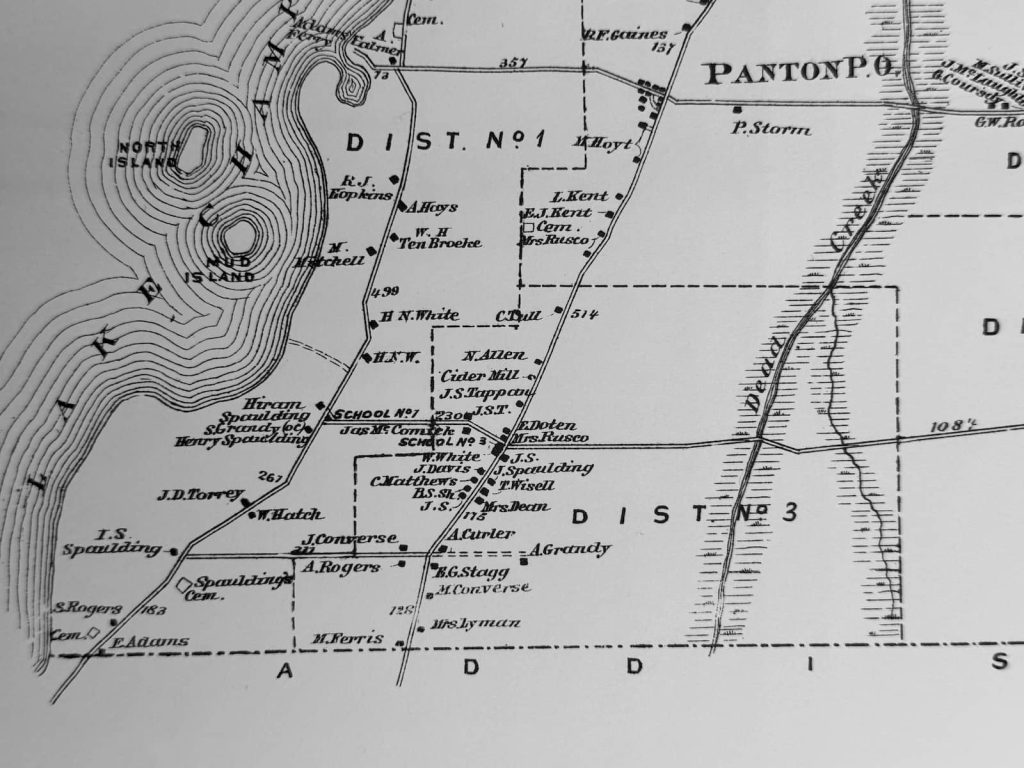

The Fifth Generation
Among Isaac Somers and Juniette’s children was Loyal Wright Spaulding (1861–1943), who remained in Panton his entire life. On September 24, 1892, he married Bertha Myrtle Kent (1872–1944), daughter of Enoch and Cornelia Kent.
Unlike many of his ancestors, Loyal’s household was a quiet one—he and Bertha never had children. Loyal died in December of 1943 at the age of 82. Bertha followed just a few months later in April of 1944. They are buried together in Vergennes, Vermont.
A Legacy of 177 Years
From Phineas Sr.’s arrival in 1767 to Loyal Wright Spaulding’s death in 1943, the Spauldings maintained an unbroken presence in Panton for 177 years. Across five generations, their lives tell the story of New England itself—frontier settlement, the trials of war, large family households, and the gradual shift from colonial hardships to the quieter rhythms of rural Vermont life.
The land they farmed, the children they raised, and the sacrifices they made remain part of Panton’s history, a legacy stretching nearly two centuries and linking the town’s earliest days to the modern age.



Share Your Thoughts